Dutch and Belgian Supermarkets Falling Short of Human Rights Standards in their Supply Chains
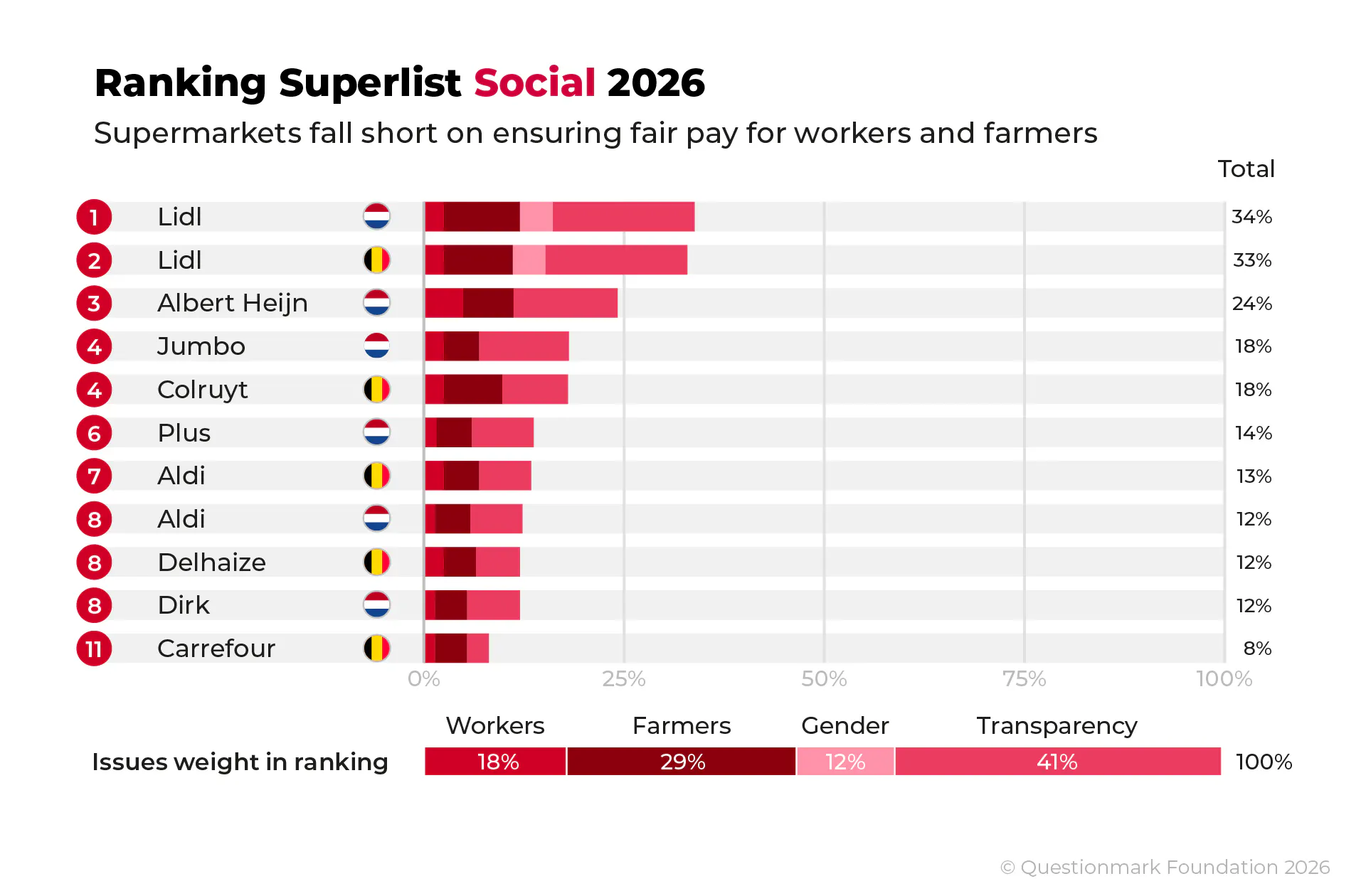
Amsterdam, April 2 — Dutch and Belgian supermarkets are falling short in implementing effective human rights measures across global supply chains, according to the Superlist Social 2026. The report highlights that while retailers are aware of risks of misconduct—including child labor and unfair pay—none are doing enough to address these issues systemically. Some progress in commodities like bananas and cocoa remain the exception; a comprehensive approach for all high-risk products is lacking. Currently all major players are failing to meet the UN Guiding Principles and OECD Guidelines.
Unfair Pay: The Root of Human Rights Impacts
A lack of fair pay is a primary driver of human rights violations, such as poverty, child labor, and forced labor. While the industry has made progress in the banana and cocoa sectors, these efforts are not yet standard practice.
Gustaaf Haan, Program Director at Questionmark, emphasizes the responsibility of the sector: "Supermarkets share the responsibility to safeguard human rights, including fair remuneration for farmers and workers, across their entire assortment. As long as this remains unachieved, they are sustaining an unfair trade model—not necessarily by intent, but certainly with full awareness."
In the Netherlands, Albert Heijn, Dirk, Jumbo and Plus have committed to enabling long-term living incomes for cocoa farmers across their private label cocoa products. Lidl has made this commitment for its private-label chocolate bars in select countries. Aldi is the only major supermarket that does not make any formal commitments to ensuring living income or living wages in these categories. All supermarkets, both in the Netherlands and Belgium, are committed to ensuring a living wage for banana workers, yet have not expanded these efforts to other high risk products. As a positive step toward broader implementation, Albert Heijn (NL) stands out for providing active technical support to its fruit and vegetable suppliers to develop action plans for measuring and addressing wage shortfalls.
Furthermore, the industry lacks structural incentives; no supermarket currently offers preferential payment terms or increased order volumes to reward suppliers that achieve fair remuneration.
Lacking Implementation—From Risk Mapping to Action
The research, conducted by Questionmark in collaboration with Oxfam Novib, Solidaridad, and Rikolto, benchmarks the largest Dutch and Belgian retailers on transparency and safeguarding human rights. While nearly all Dutch retailers have mapped their high-risk supply chains, only 40% (two out of five) of the largest Belgian retailers have done so. The report finds that across both markets insight is not leading to action. Lidl (BE & NL) continues to lead the rankings due to its use of targeted action plans, but civil society organizations urge a broader scope.
Heske Verburg of Solidaridad notes: “Supermarkets have identified where the risks lie; it’s time for action. Success in the cocoa and banana sectors proves that progress is possible. It is now essential to expand these efforts across all high-risk supply chains—starting, for example, with coffee.”
Compliance Pressure: The Looming CSDDD Reality
The report's findings highlight the significant transition ahead as the Corporate Sustainability Due Diligence Directive (CSDDD) moves toward full application. The directive will legally mandate all major retailers in this study to identify and address human rights violations in their supply chains by 2029[1]. A major area of concern is a lack of grievance mechanisms; not a single benchmarked supermarket currently maintains effective channels for reporting abuses in supply chains. This failure to implement robust channels leaves the majority of the sector ill-prepared for the level of accountability required under the new directive.
Thibault Geerardyn of Rikolto: "The upcoming European legislation reflects citizens' demand for accountability. They increasingly voice their concern, as they do not want to contribute unknowingly to human rights violations through their food purchases. The good examples in this report should serve as an urgent inspiration, so that supermarkets can live up to this societal demand."
Gender Equity: A Persistent "Blind Spot"
The report identifies a significant "blind spot" regarding women’s rights. Despite acknowledging that women earn significantly less in agricultural chains, no supermarket has implemented a plan to close the gender wage gap. Lidl forms the exception, which has active roadmaps for both pay equity and the prevention of violence against women. However, the report notes that these plans are not yet accompanied by publicly reported measures.
Underpayment as a Business Model
Eline Achterberg, Retail Expert at Oxfam Novib, emphasizes that systemic change requires moving beyond short-term margins:
"Underpayment is not an incident; it is a business model. Supermarkets continue to prioritize margins over social sustainability, leaving farmers and workers—particularly women—to pay the price. Retailers have the market power to change this; they must now choose to use it."
Go to Superlist Social 2026