UK supermarkets found wanting on sustainability in new Europe-wide ranking
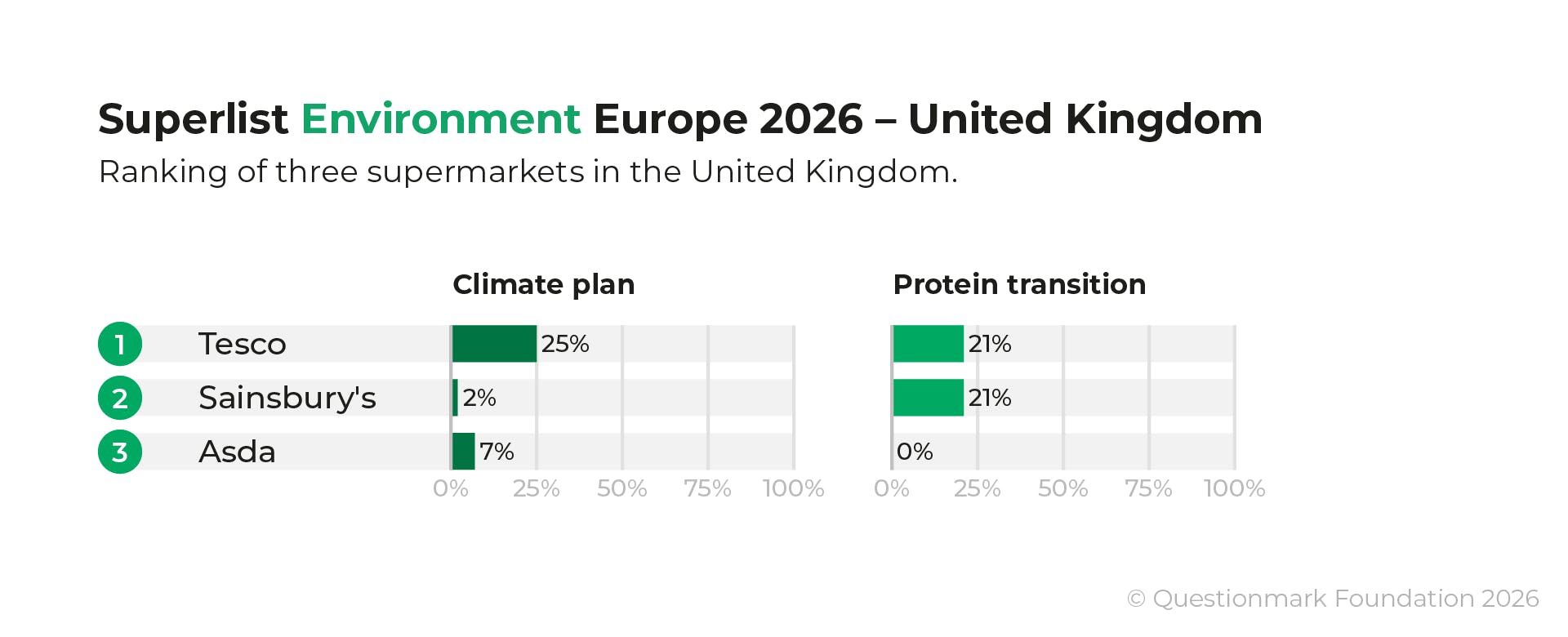
- New benchmark shows top three UK supermarkets by market share lag European counterparts on climate and protein transition plans.
- Tesco just outside top ten but far behind German and Dutch supermarkets.
- None of the UK retailers ranked in the benchmark have yet followed European leaders in setting specific goals to increase the share of plant-based proteins in their sales - the single most effective way of reducing emissions from food.
January 27th, 2026
Asda, Sainsbury’s and Tesco lag behind many of their European counterparts on crucial sustainability indicators, according to a new benchmark of 27 supermarkets across eight countries.
The Superlist Environment Europe, launched today by sustainability think tank Questionmark in association with NGOs WWF Netherlands, ProVeg International and Madre Brava, looked in detail at the climate plans of the top three supermarkets by market value in eight countries and found promising signs but rising emissions and a negative overall picture.
Supermarkets have a major influence on how their suppliers produce food and what their customers buy. While some have published detailed roadmaps for emissions reductions, actual emissions continue to rise.
Crucially, few in the Europe-wide ranking, which is also supported by The Food Foundation and Changing Markets in the UK, take responsibility for reducing sales of animal protein and increasing those of plant-based protein. Meat and dairy make up around 60% of GHG emissions from food, and around 31% of all methane globally, making rebalancing protein sales one of the most effective measures to cut emissions in line with the Paris Agreement. It is also one that could save consumers money, and be better for their health.
Tesco, the largest supermarket by market share in the UK, is ranked at number 11 in the Superlist Environment Europe. The supermarket has a near-term emissions reduction target across its operations and value chain and reports its ‘protein split’ - the proportion of proteins it sells that are plant-based and those that are animal-based. It also financially supports its suppliers in reducing their environmental impact
However, it loses ground on European counterparts by failing to set a protein split target and has no published roadmap to translate 2030 targets into actionable and quantified emissions reduction measures.
Sainsbury’s, which comes 17th, has not reported its scope 3 emissions (those from its value chain) since 2018/19. Regular scope 3 reporting is essential to assess progress against targets. It also reports its protein split but has also not yet set a target to rebalance sales towards plant-rich products.
Asda, which is ranked 22nd of 27 supermarkets, reports its emissions across its operations and value chain, but its emissions have risen overall since its 2015 baseline, despite a recent decrease. The supermarket wants to increase the amount of plant-based protein it sells as part of its sustainable and healthy diets plan but has not set a quantitative target and does not explicitly state the need to reduce sales of animal-based products.
Lidl GB, the UK’s fastest-growing supermarket which is not in the ranking because it is outside of the top three by market share, has grown plant-based sales by 700% in the last five years and has an ambitious protein balance goal to align its sales with the EAT-Lancet Planetary Health Diet by 2050. This shows market success and action on protein diversification can go hand in hand. Lidl has also called for mandatory healthy food sales reporting to include plant-based targets.
Sara Ayech, UK Director for Madre Brava said: “Here in the UK, we buy so much of our food from supermarkets, so it’s essential that they have robust plans to reduce their emissions. Switching a proportion of protein sales from animals to plants would be good for their customer’s health and wallets, good for the planet and good for business. But they’re lagging behind leaders in the Netherlands and Germany.”
Speaking about the full Superlist Environment Europe, Questionmark’s Director Charlotte Linnebank said: “We hope all European supermarkets step up with clear roadmaps, concrete targets, and transparent reporting, to ensure the food on the supermarket shelves is sustainably produced. This Superlist shows it’s possible, and frontrunners can inspire others to follow suit and build a more sustainable food system together.”
--
For press related questions contact: Jon Bennett - jon@madrebrava.org