Major gaps in European supermarkets' climate and protein transition performance: leaders are emerging but many are falling behind
First European benchmark of 27 supermarkets across 8 countries highlights leaders and gaps in climate action and protein transition: Dutch and German chains are leading, but none show strong reductions in greenhouse gas emissions.
- Detailed roadmaps to reduce emissions have been published by seven supermarkets.
- Emissions of many supermarkets are still rising.
- The role in shifting to more plant-rich diets is recognised by two-thirds of supermarkets.
- The international sustainability race is being led by discounter Lidl.
27 January 2026 - Europe’s supermarkets could make or break the food system’s climate impact, but few act on this responsibility, according to a new benchmark, Superlist Europe Environment 2026, released today.
The initiative led by think tank Questionmark, in collaboration with partners WWF Netherlands, Madre Brava, and ProVeg International and with the support of ambassadors Changing Markets, Climate Action Network France, PAN DACH, RoślinnieJemy, Spanish Vegetarian Union and The Food Foundation, compares 27 supermarkets across eight countries: France, Germany, the Netherlands, Poland, Spain, Sweden, Switzerland, and the UK.
The benchmark assesses performance in two key areas: alignment of their climate plans with the Paris Agreement and their efforts to shift protein sales toward plant-rich diets. The more transparent a supermarket is and the more targets it sets, the higher it can score on the indicators. For example, a supermarket may score high on the Climate Plan indicator if it has ambitious emission reduction targets. Similarly, it may score high on the Protein Transition indicator if it reports the share of animal- versus plant-based products in its total sales volume. See our methodology for more details.
It shows that supermarkets in Germany, the Netherlands, and particularly Lidl throughout Europe, are setting the pace in Europe’s transition toward sustainable food systems.
Leaders such as Albert Heijn, Lidl (in four countries), Jumbo, REWE, and Aldi Süd demonstrate the strongest commitments to cutting emissions, amongst others, by rebalancing protein sales. Lidl’s success in Europe is evident, as it ranks high compared to its local competitors in all countries where the supermarket chain is assessed. The lower-ranked supermarkets are falling behind because they show little ambition in climate plans and make little to no effort to rebalance protein sales.
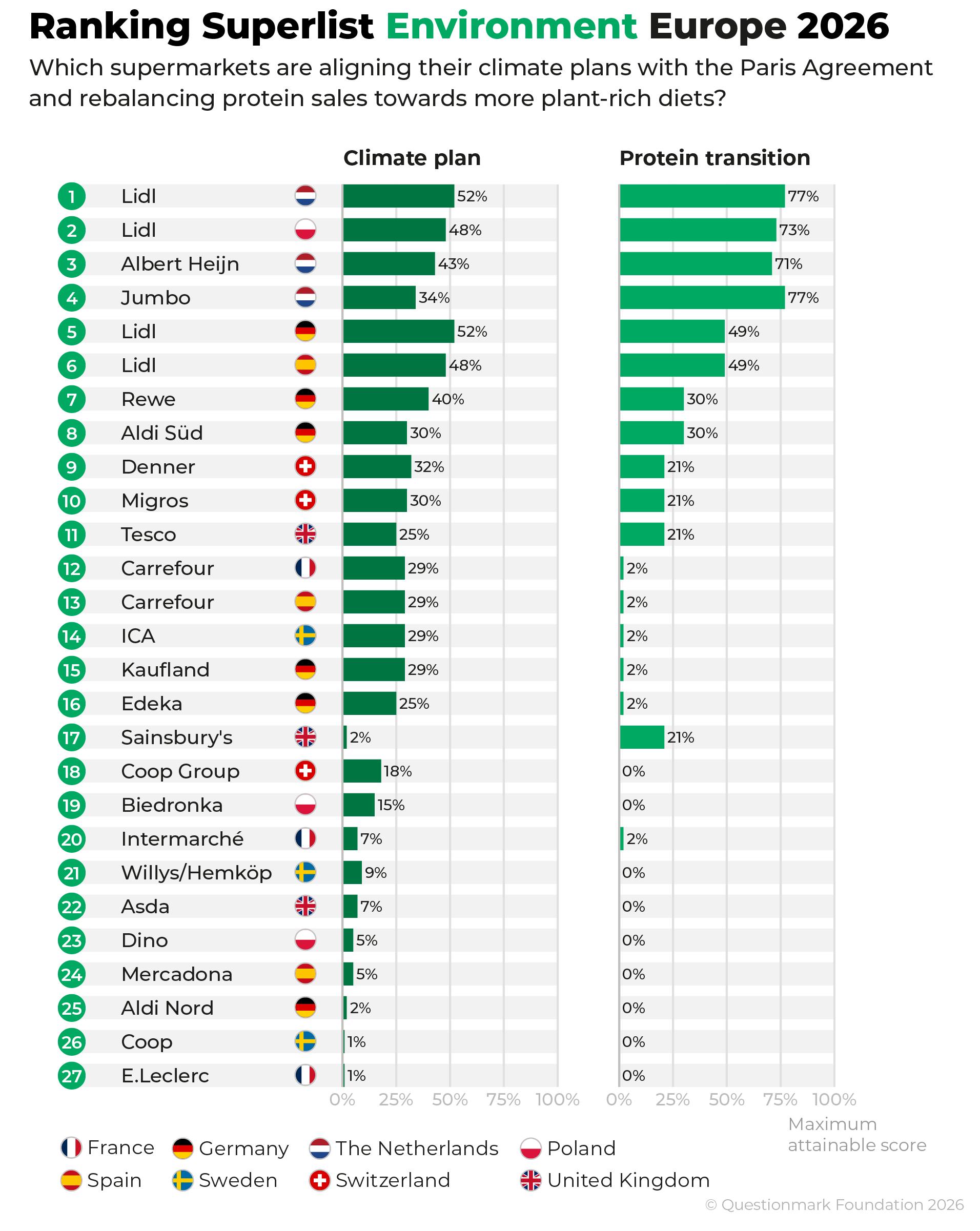
No strong emission reductions yet - interventions are needed
Emission reductions and reporting progress towards, preferably near-term, targets are key to contributing to the Paris Agreement. To date, only five supermarkets, ICA, Jumbo, Kaufland, Migros, and REWE, have managed to cut emissions since they began reporting, the majority have not reduced emissions.
In fact, many European supermarkets have seen total emissions rise in recent years. Moreover, inconsistent reporting of emissions makes it difficult to assess real progress, highlighting the urgent need for standardised reporting aligned with the Paris Agreement.
First supermarkets are rebalancing their sales volumes of protein
A crucial step for supermarkets to reduce their emissions is to rebalance their sales of protein. Shifting toward more plant-based proteins (e.g., beans, legumes) would create healthier diets and lower indirect (Scope 3) emissions, as the production of animal-based products is a key driver of global greenhouse gas emissions. Supermarkets in Germany, the Netherlands and Lidl in many other European countries are trendsetters, disclosing the protein balance in their sales and setting targets to increase plant-based sales in line with the Planetary Health Diet. Yet, one in three European supermarkets, particularly in France, Poland, Spain, Sweden, and the UK, has taken no action to rebalance protein sales, despite the crucial role it plays in achieving emission reduction.
Supermarkets urged to publish detailed roadmaps
Since there is no clear downward trend in emissions, supermarkets must publish detailed roadmaps outlining how they plan to lower them. Only seven European supermarkets have disclosed such plans, including Albert Heijn (Netherlands), Carrefour (France and Spain), and Lidl (Germany, Spain, the Netherlands, and Poland). Nineteen supermarkets do have near-term reduction targets, but lack detailed roadmaps. It is therefore crucial that the 20 supermarkets that do not yet have detailed roadmaps immediately develop and publish them, including near-term targets, in line with the Paris Agreement.
Leading or Lagging
Whether leading or lagging, all supermarkets have powerful positions in food value chains to reduce emissions and shift diets to become more plant-rich. However, each supermarket in the Superlist Environment Europe still has progress to make in taking full responsibility - the Superlist provides clear guidance on which steps they should take.
Quotes Partners
“Supermarkets have the power to shape a healthier and climate friendly food system. Despite a few frontrunners, the sector is far from using its full leverage. This report shows best practices and outlines concrete steps for each supermarket to take - such as publishing near-term reduction targets and detailed action plans, and rebalancing sales of animal versus plant-based proteins.” says Charlotte Linnebank, Director Questionmark.
Nico Muzi, Cofounder and Chief Programmes Officer at Madre Brava, said: “In Europe we eat too much protein and not enough fibre. That’s why doctors and nutritionists recommend eating more fruit, veg and legumes and less meat. “Supermarkets can play a positive role in meeting this challenge by setting targets to rebalance protein sales to sell more plants. By looking after their customers’ health, they’re also looking after the planet and their own business interests, as more plants means lower emissions and lower costs.
“So far, the Dutch and German retailers are leading the way. We urge the British, Spanish and French retailers to catch up and ensure good, healthy food is affordable to all.”
Dr Joanna Trewern, ProVeg International’s Director of Partnerships and Institutional Engagement, said:
“The Superlist report shows that leading retailers are increasingly starting to recognise their central role in enabling consumers to choose healthy and sustainable plant-rich diets. Yet we are still a long way from retailers across Europe universally taking up the challenge.
“Without supermarket ambition and transparency on plant-rich diets, a vital piece of the roadmap towards mitigating the worst impacts of climate change is missing. And given that animal-based foods account for 50% of supermarket emissions on average, supermarkets will also be unable to achieve their own net zero goals.
“The success of supermarkets in the Netherlands - where the whole retail sector has united around common protein diversification targets and reporting - shows what is possible when there is leadership and coordination. Now we need to see other major businesses step up to help us all choose food that is better for us, and the planet.”
--
For press related questions please contact:
Questionmark: Nina Charbon | nina.charbon@thequestionmark.org
Madre Brava: Jon Bennett | jon@madrebrava.org
ProVeg International: Peter Rixon | peter.rixon@proveg.org